For businesses reviewing cybersecurity alerts, CISA’s October 20, 2026 announcement identifies six vulnerabilities added to its Known Exploited Vulnerabilities (KEV) Catalog. CISA says the additions are based on evidence of active exploitation. That is the agency’s stated basis for listing them, not independent confirmation that any particular business has been affected.
The Plex Media Server entries are CVE-2026-96652 and CVE-2026-96655, both described as server-side request forgery vulnerabilities; CVE-2026-96654, involving improper neutralization of encoded URI schemes in a web page; and CVE-2026-96656, involving external control of a file name or path. The other entries are CVE-2026-106931, an OS command injection vulnerability in EG Secure Solutions SiteGuard Server Edition, and CVE-2026-110936, an uncontrolled search path element vulnerability in Siemens Software Center.
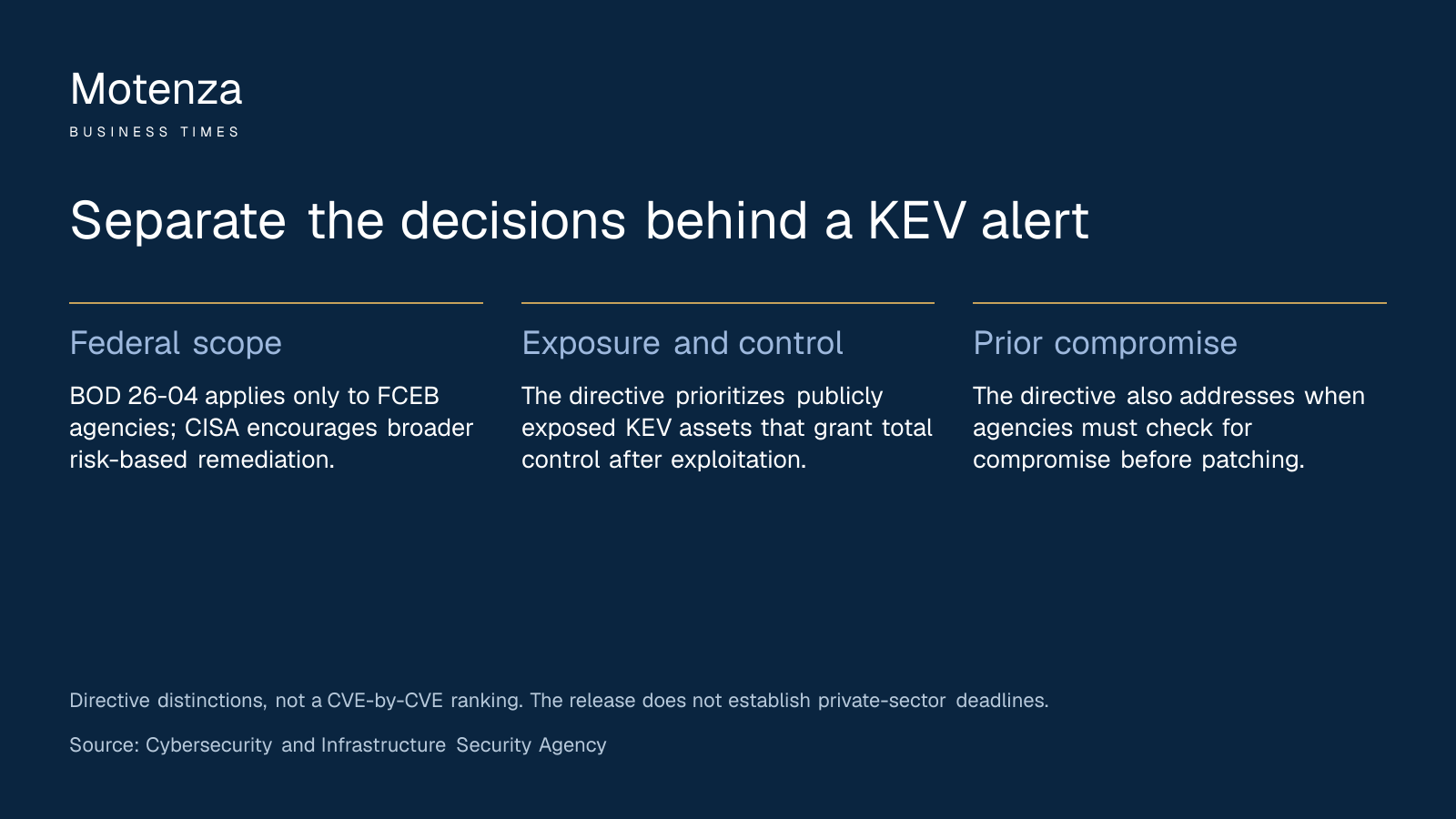
The useful business distinction is between a catalog match and a remediation order. CISA says Binding Operational Directive (BOD) 26-04 establishes requirements for Federal Civilian Executive Branch (FCEB) agencies. It expressly limits the directive’s applicability to those agencies while encouraging all organizations to prioritize KEV remediation through risk-based vulnerability management. The release does not establish a universal private-sector deadline.
A reproducible review should begin with an asset-to-CVE worksheet covering every listed entry, rather than a queue ordered by product name. For each entry, ask the system owner to record whether the product is present, its installed version, and whether current vendor guidance confirms applicability. Mark an unconfirmed match as unresolved, not unaffected. This method assumes the organization can obtain an inventory and authoritative product guidance.
Next, distinguish confirmed applicability from exposure and impact. The directive’s stated priority concerns KEV vulnerabilities on publicly exposed assets that grant total control after exploitation. Use those as separate review questions, not as properties automatically shared by every entry. The supplied release does not map those conditions to individual CVEs, identify affected versions, or provide enough detail to rank these products against one another.
For each confirmed match, request documented answers about public exposure, the consequences described in authoritative guidance, and the available defensive action. Record unknowns explicitly. Under this proposed method, an unresolved exposure question triggers investigation rather than a low-risk designation. It is a triage framework, not a technical claim that any listed product necessarily permits total control or that an unexposed installation is safe.
Keep remediation and compromise assessment as separate decisions. CISA says BOD 26-04 sets expectations for when agencies must check whether compromise occurred before patching. A business applying that distinction should ask what evidence its security team needs to assess possible prior compromise, alongside the remediation plan. The announcement supplies neither investigation steps nor a finding that a particular installation was compromised.
The resulting management record should show which listed entries were checked, which applicability or exposure questions remain open, and what information supports each proposed action. This makes the alert useful without inventing a severity ranking. Before scheduling changes, the missing inputs remain product-specific mitigation instructions, verified installation details, and the organization’s own operational constraints; the release alone cannot settle the work order.
What this means for your business
The concrete decision is where to direct assessment and remediation effort, not whether every listed product deserves the same response. A confirmed applicable vulnerability with documented public exposure warrants a different review from an unconfirmed inventory match. The source does not supply enough installation-level evidence to prescribe that ordering for a particular business.
Context and alternatives
Use an inventory-first review when product applicability is unknown; use a remediation-and-compromise review when applicability is confirmed. These are different starting points, not competing security guarantees. Neither path should treat a missing inventory record as proof of absence or import federal requirements as a universal private-sector mandate.
Primary sources
- Cybersecurity and Infrastructure Security Agency · Checked October 26, 2026
Send a correction to corrections@motenza.com.