Read this report alongside the linked primary sources. Distinguish the announced event from its potential effect on your business.
A year inside a simulated Mars habitat
NASA reported on October 19 that the CHAPEA Mission 2 crew had spent a year living and working in its simulated Mars habitat in Houston. The mission studies people operating with constrained resources and delayed communications on Earth. It is not a crewed flight to Mars. The agency’s report describes work including crop growing, maintenance and simulated surface activities, with the crew’s exit and later evaluations still separate milestones. The value of the exercise lies in observing how a team manages a demanding system over time, rather than treating a single photograph of the habitat as proof that every challenge of a real Mars mission is solved.
A useful leadership question is how the team adapts
A long-duration operation exposes differences between a procedure that works once and a routine people can sustain. Readers interested in management can ask how responsibilities, handoffs and recovery time are organized when support is not immediately available. That is a question to investigate, not a claim that NASA’s study has already produced a universal formula for office teamwork. An Earth-based simulation also has boundaries that differ from spaceflight. The useful comparison identifies both the constraint being studied and the conditions that are absent, so the result is not transferred to another setting without considering what changes.
Follow the analysis after the visible milestone
The anniversary is a clear news moment, while the scientific work continues through later evaluation and analysis. Watch for descriptions of methods, measured outcomes and the limits of what the simulation can establish. For a business reviewing its own continuity plan, the immediate practical exercise is smaller: identify who can take over a critical task, what information is needed and how a delayed response affects service. Test those questions in normal operations without attempting to reproduce a research habitat. The strongest lesson is to observe performance over time and document adaptation, while keeping the NASA mission’s findings distinct from an editorial analogy about workplace planning.
Image source and usage
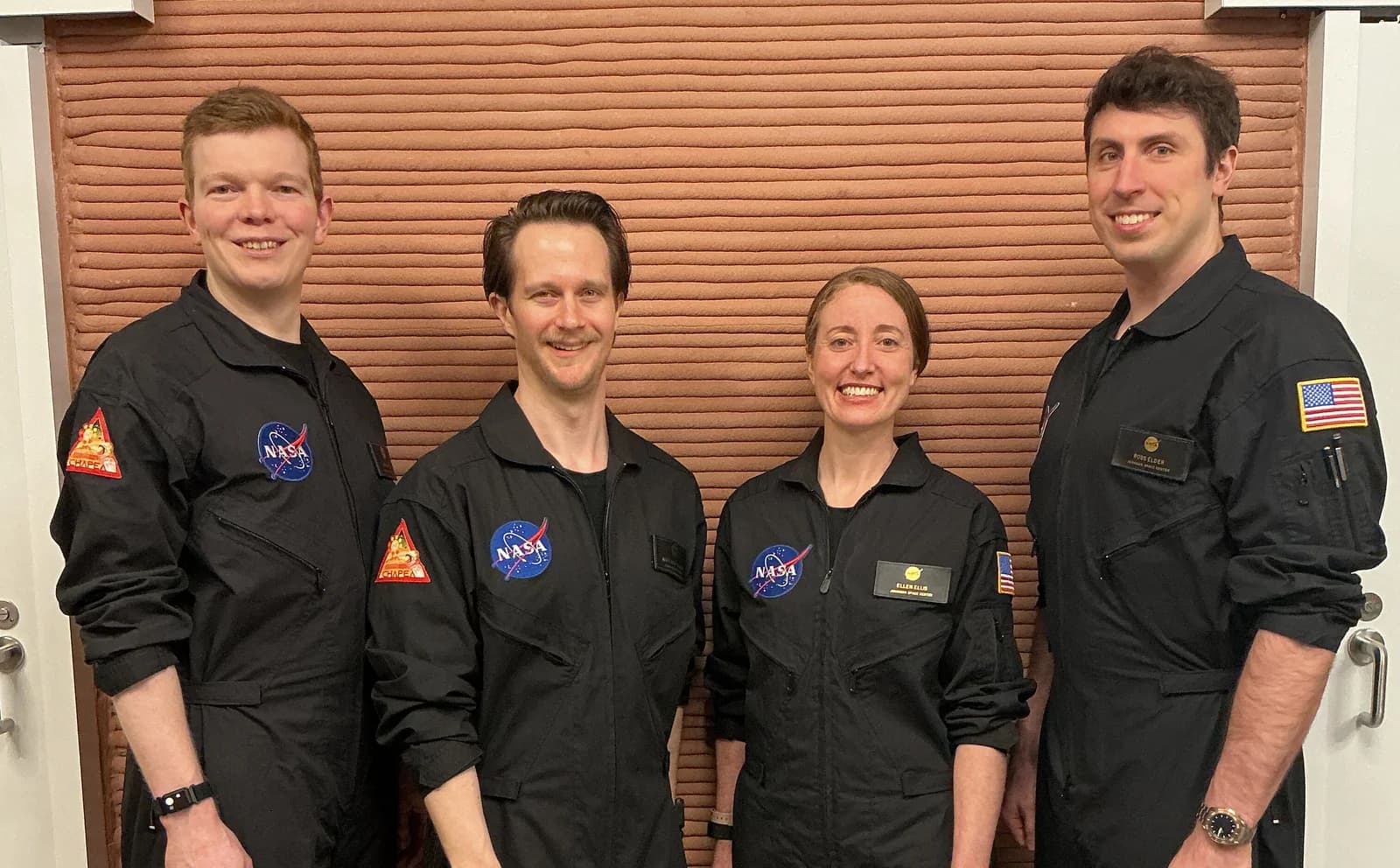
The CHAPEA Mission 2 crew inside the simulated Mars habitat at NASA Johnson Space Center
NASA
Source image · Image-use terms
Web versions are resized and compressed; attribution and applicable source terms are retained.
Frequently asked questions
Are the CHAPEA crew members on Mars?
No. CHAPEA is an Earth-based analog study at NASA’s Johnson Space Center in Houston, designed to investigate aspects of long-duration exploration.
Sources & further reading
Source links checked October 19, 2026. Rules and availability may change; verify current terms directly. Read our editorial standards.