For businesses following IRS tax updates, the key distinction in the October 21, 2026, release is between relief for a particular liability and relief from an entire return. The announcement covers specified compliance failures tied to taxable uses of dyed diesel. It does not give every affected business permission to stop filing Form 720 or maintaining records used for other tax purposes.
The IRS says it will not challenge temporary filing, reporting or recordkeeping failures solely attributable to section 4041(a) liability arising from taxable uses of dyed diesel on or after October 1, 2026, and before January 1, 2027. It also will not assert civil penalties or additions to tax solely for failures covered by the announcement. Those conditions define the relief; fuel type alone is not the complete eligibility test.
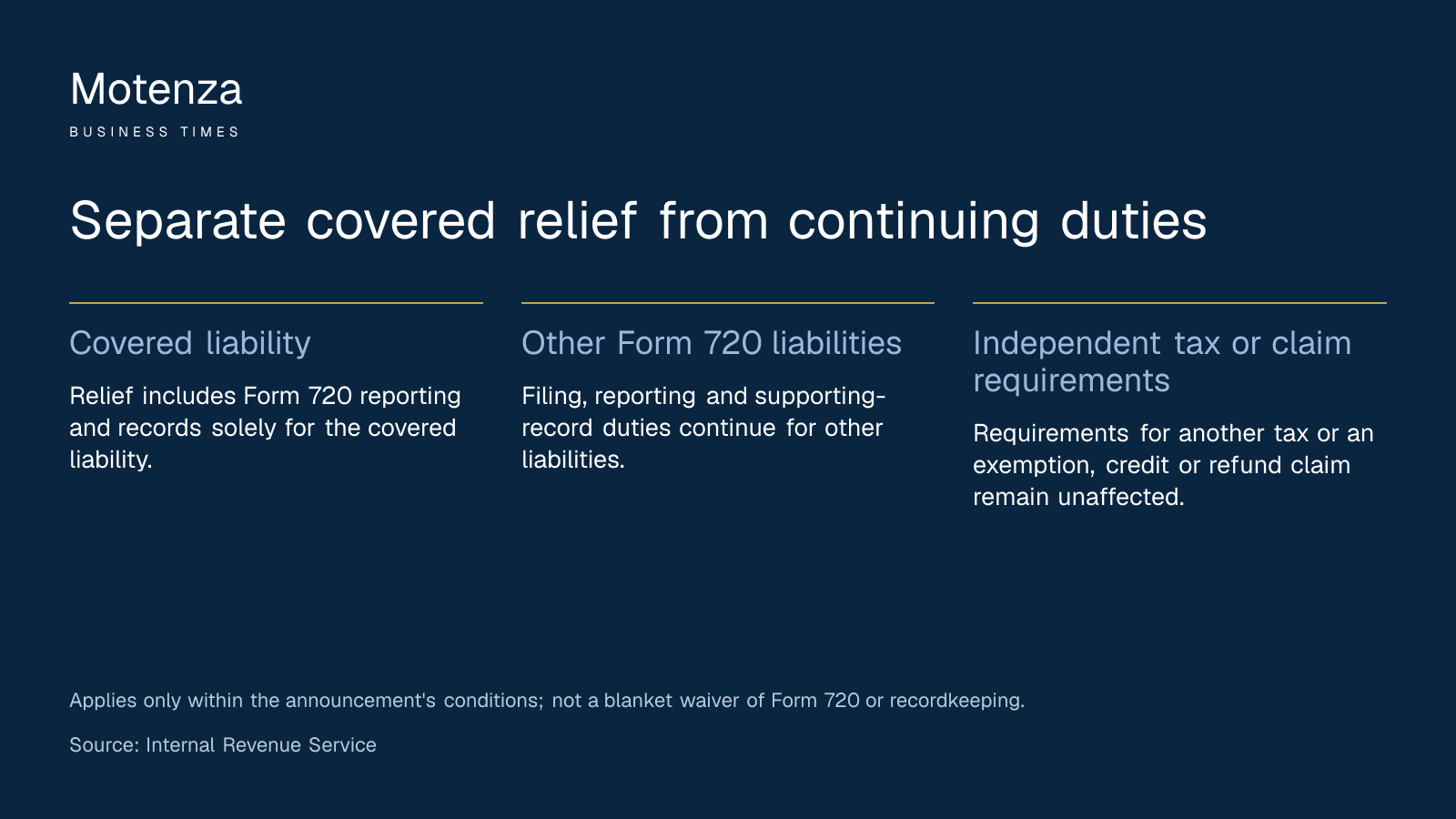
The announcement expressly includes filing Form 720 solely for that liability, reporting the liability on an otherwise required Form 720, and creating or maintaining records solely to substantiate it. Separately, it says businesses with other Form 720 liabilities must continue filing, reporting and keeping supporting records. A return can therefore remain required even when reporting a covered liability receives relief.
A practical review method is to classify each obligation by its purpose rather than treat the return as an indivisible package. For each filing, report or record, ask whether it serves only the covered section 4041(a) liability, another Form 720 liability, or another tax or claim. This framework assumes the business can identify the relevant fuel uses and the purpose of each obligation; the release cannot supply those business-specific facts.
That purpose test matters especially for shared records. If a record also supports another tax or a claim for exemption, credit or refund, this announcement does not remove the independently applicable requirement. Before changing a retention process, the business would need to establish what else the record supports. Administrative relief for one purpose is not a sound basis for treating a multipurpose record as unnecessary.
Timing requires a separate check. The relief applies even if the filing or reporting deadline falls after December 31, 2026, and the IRS says it will not require subsequent filing, reporting or reconstruction of records after that date. For a covered obligation, the announcement therefore describes more than a postponement. A review should start with the date of the taxable use, not exclude an obligation merely because its deadline comes later.
The boundary after the relief period remains important. The IRS says it is considering a grace period or other mitigation for residual red dye in fuel tanks, with further guidance to follow. That is a pending possibility, not an announced extension. Businesses should keep any transition assumption separate from the relief already described and check for subsequent guidance before relying on a grace period.
The resulting decision is narrow: identify which compliance work is covered, preserve obligations with independent purposes, and avoid treating this announcement as a determination of tax payable. Its stated subject is administrative relief while simplified procedures are evaluated. Without the business's other liabilities, claims and fuel-use details, the release alone cannot establish the full filing position or justify a tax-payment reduction.
What this means for your business
The potential operational benefit is avoiding covered compliance work without dropping duties that remain. Before changing a filing calendar or record-retention process, identify other Form 720 liabilities and any exemption, credit or refund claims that depend on the same records.
Context and alternatives
Where an obligation serves only the covered liability, assess it against the relief conditions. Where other Form 720 liabilities exist, continue the required return and supporting work for those liabilities. Where records have mixed purposes, retain what the independent requirements demand rather than applying a blanket removal policy.
Primary sources
- Internal Revenue Service · Checked October 25, 2026
Send a correction to corrections@motenza.com.